Nullbox
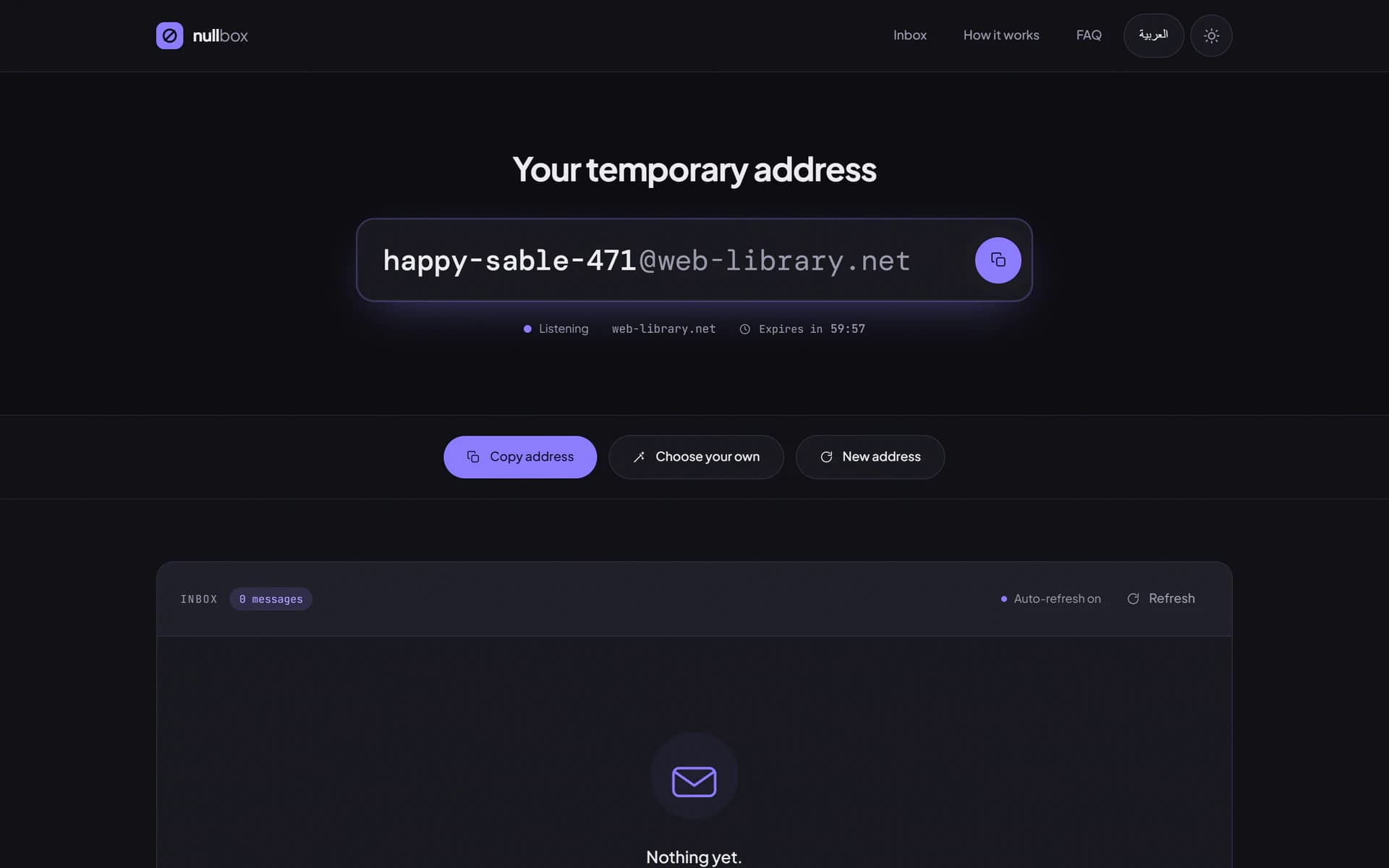
Disposable email, designed as an editorial object rather than a dashboard wrapped in advertising.
- Platform
- Web
- Year
- 2026
- Role
- Full-stack developer
The challenge
Every temp-mail service buries the one thing you came for. The generated address — the entire product — sits in a small grey input surrounded by banner ads, and you squint to copy it correctly.
The approach
The address is the hero, set at up to 76 pixels. The identity is Swiss editorial and deliberately austere: paper, ink, one acid accent, hairline rules, corners no softer than two pixels — no gradients, no shadows, no glass. The mark is an empty-set glyph squared off, a hard container holding nothing.
The result
Copying the address is the first thing you can do rather than the thing you hunt for, and the page loads without a single third-party request.
Highlights
- The address is the interface — Set at up to 76 pixels with a copy button beside it — the first thing you can do, not the thing you hunt for.
- Addresses you can read aloud — Like quiet-harbor-418@ rather than x7f2q9@ — and you can pick the name and the domain yourself.
- A live inbox — Mail arrives, opens and is deleted on the same page, with its content sanitised and shown inside a sandboxed frame.
- The relay never sees the visitor — Every request goes through this app’s own routes, so the upstream service never receives a visitor’s IP address.
- Arabic and English — Two separate route segments with real RTL, negotiated automatically from the request header.
- Zero third-party requests — No ads, no trackers, no CDN fonts — the page loads from a single origin.
Built with
- Next.js 14
- React
- TypeScript
- Tailwind CSS
Next project
Templets